Divorce Checklist for Men: Protect Your Rights in 2026
Written and reviewed by the divvi team. How we research and check this.

Your divorce checklist for men starts here
The first 30 days after deciding to divorce will shape your outcome more than almost anything that follows. Men who arrive prepared keep more assets, secure fairer custody arrangements, and spend less on legal fees. Those who react instead of plan often spend months recovering ground they never had to lose.
Here is what to do immediately:
- Pause before acting. Avoid impulsive decisions in the first 72 hours, including packing, sending angry texts, or making large financial moves. Your nervous system is in crisis mode. Let it settle.
- Gather financial documents. Bank statements, tax returns, pay stubs, investment accounts, retirement statements. Start pulling everything now.
- Secure personal belongings. Valuables, sentimental items, and important paperwork should be in a safe location you control.
- Open individual accounts. A new checking and savings account in your name only gives you financial footing without touching joint funds improperly.
- Change passwords. Email, banking, social media, cloud storage. Do this before your spouse does.
- Update your mailing address. Redirect sensitive mail to a P.O. box or trusted address.
- Build a post-divorce budget. Know what your monthly expenses look like on a single income before the process begins.
Table of Contents
- How to gather the financial and legal documents you need
- How to secure your finances and manage accounts during divorce
- How to plan a realistic budget for post-divorce life
- What personal and custody documents fathers need to collect
- Why consulting a divorce attorney early changes your outcome
- When and how to move personal belongings
- How to prepare for court appearances and mediation
- What you need to know about child support and alimony
- How to handle joint debts and credit accounts
- What happens to your health insurance and benefits after divorce
- How to organize evidence related to marital assets and property
- Divvi makes the process manageable for Utah men
- Key Takeaways
How to gather the financial and legal documents you need
Courts run on paper. The more organized your documentation, the stronger your position during property division, support negotiations, and custody proceedings.
Organize documents by financial institution, then by month and year. A binder or digital folder per institution keeps things findable when your attorney asks for them at 9 PM the night before a hearing.
What to collect:
- Bank statements (checking and savings) for several years
- Federal and state tax returns for several years
- Pay stubs and income documentation for both spouses
- Investment and brokerage account statements
- Retirement account statements: 401(k), IRA, pension plans
- Property deeds and mortgage statements
- Vehicle titles
- Prenuptial or postnuptial agreements
- Business ownership records and profit/loss statements
- Outstanding debt records: credit cards, auto loans, student loans
Pull a comprehensive credit report early. It shows every account in your name, joint or otherwise, and flags anything you may have forgotten. If you hold cryptocurrency, document wallet addresses, keys, and transaction histories. Digital assets are marital property in most jurisdictions when acquired during the marriage.
Pro Tip: Photograph physical assets like vehicles, art, collectibles, and jewelry with timestamps. Visual evidence of condition and existence is harder to dispute than a verbal claim.

How to secure your finances and manage accounts during divorce
Financial protection during divorce is less about aggression and more about positioning. The goal is to have access to your own funds without giving a court reason to question your good faith.
- Open an individual checking account and redirect your payroll direct deposit there.
- Keep a separate savings account for legal fees and emergency expenses.
- Do not empty joint accounts. Large, abrupt withdrawals can be treated as financial misconduct, and courts expect both spouses to act in good faith during proceedings.
- Set up real-time alerts on all joint accounts so you know immediately if unusual transactions occur.
- Change passwords on personal email, financial accounts, and any shared subscriptions you want to retain.
- Request a credit freeze on unused joint credit lines to prevent new debt from being opened.
Pro Tip: Rather than closing joint accounts outright, ask your bank to set a spending limit that requires both signatures for withdrawals above a set amount. It reduces conflict and protects both parties without triggering legal scrutiny.
Men often find that separating financial control early shifts their focus from emotional reaction to practical protection. Redirecting income and limiting joint account access is not about punishing your spouse. It is about making sure you can pay your attorney and your rent.
How to plan a realistic budget for post-divorce life
Most men underestimate how much their monthly costs will rise after divorce. Going from a two-income household to a single income, while potentially paying child support or alimony (spousal support), requires a clear-eyed financial plan before the process concludes.
- Calculate your current monthly living expenses and then model what they look like without your spouse's income contribution.
- Factor in new costs: separate housing, individual health insurance, utilities, and any increase in childcare expenses.
- Identify which joint bills will need to be split, transferred, or closed: utilities, subscriptions, insurance policies.
- Understand how child support and alimony obligations will affect your net take-home pay. Both are calculated based on income and custody arrangements, so get estimates early.
- Build an emergency fund of several months of living expenses. Divorce proceedings can drag on, and unexpected legal costs are common.
- Revisit retirement contributions. If you reduce them during the divorce to cover legal fees, build a plan to restore them once the process ends.
For deeper guidance on post-divorce financial planning, including how to rebuild savings and restructure your budget after the decree, the groundwork you lay now makes that recovery significantly faster. A personal finance review can also help you identify where to cut and where to protect.
What personal and custody documents fathers need to collect
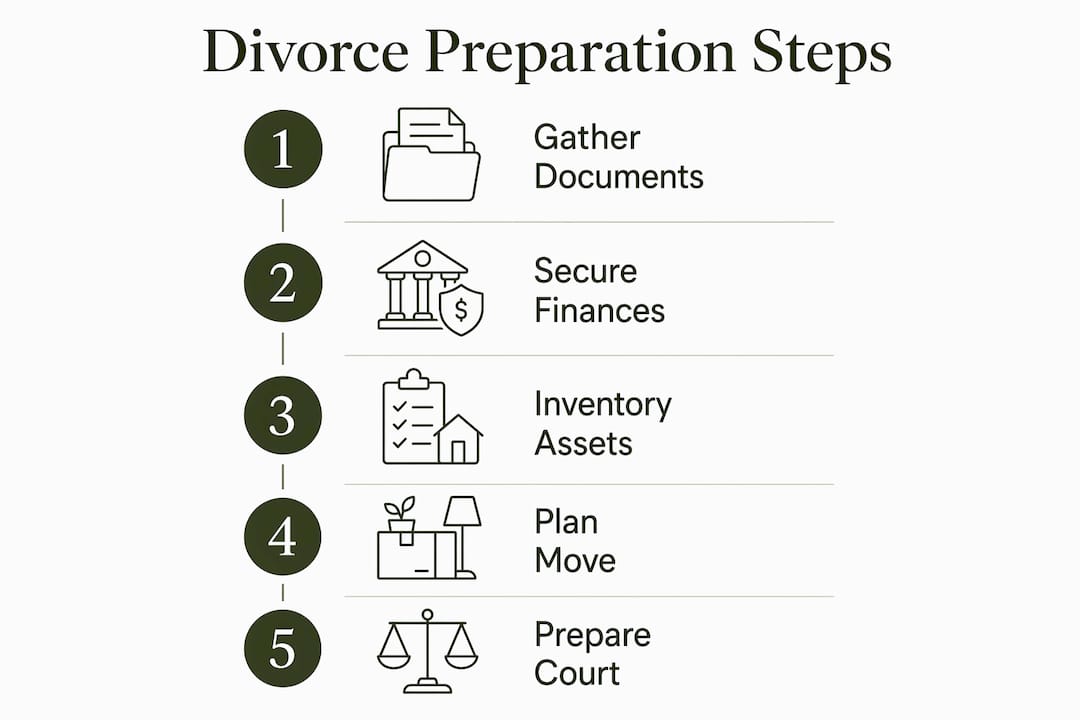
For men with children, the documentation checklist extends well beyond finances. Courts look for specific, verifiable evidence of parenting involvement. Vague claims about being a good father carry far less weight than a timestamped record of school pickups, medical appointments, and bedtime routines.
Gather the following:
- Children's birth certificates and Social Security numbers
- School contacts, report cards, teacher emails, and sign-in sheets
- Pediatrician and specialist contacts, vaccination records, and prescription histories
- Documentation of any special needs, therapies, or treatment plans
- Extracurricular activity schedules and your involvement in them
- Marriage certificate, passports, and any existing legal documents like wills or powers of attorney
Start a detailed parenting log now and maintain it consistently. Record dates, times, and activities: school drop-offs, homework help, medical visits, sports games. Courts rely on documented evidence over feelings, and a detailed log of consistent involvement over time is far more persuasive than testimony alone. A family management plan tool can help you organize and track this information in a format courts recognize.
Why consulting a divorce attorney early changes your outcome
An attorney is not just someone you call when things go wrong. Early legal consultation shapes your entire strategy, from how you file to how you handle temporary orders.
- Residency requirements matter. Eligibility to file depends on your jurisdiction. For example, New York requires one year of continuous residence in many cases under DRL § 230. Filing in the wrong jurisdiction wastes time and money.
- An attorney explains how your state handles property division, whether community property or equitable distribution, and what that means for your specific assets.
- Legal counsel helps you prepare for temporary court orders covering custody, support, and use of the family home. These early orders often set the tone for the final decree.
- Attorneys review financial disclosures and draft or evaluate settlement agreements before you sign anything.
- Early consultation prevents the most common costly mistakes: hiding assets (which courts penalize severely), missing discovery deadlines, and making statements that damage your credibility.
When and how to move personal belongings
Moving out of the family home is one of the most consequential decisions you will make during divorce, and timing matters enormously. Leaving without a court order or parenting plan in place can be interpreted as abandonment, which directly affects custody rights.
Before you move anything, consult your attorney. If you do need to leave, document what you take with photos or video, ideally with a witness present. Focus on personal items: clothing, toiletries, important documents, and items with clear sentimental or personal value. Do not remove items that could be classified as marital property without legal guidance.
If you stay in the home during proceedings, establish clear boundaries and keep a record of any incidents. Either way, the decision should be deliberate and legally informed, not emotional.
How to prepare for court appearances and mediation
Courts form impressions quickly. How you present yourself, both in person and on paper, affects how a judge perceives your credibility.

Dress conservatively: a clean, pressed shirt, muted tie, and polished shoes. Arrive early. Sit upright, speak slowly, and finish your sentences cleanly. During cross-examination, pause before answering. Avoid sarcasm entirely.
Mediation is often faster and less expensive than litigation. A neutral third party helps both spouses reach agreements on custody, support, and property. Come to mediation with your financial documents organized, a clear sense of your priorities, and a realistic understanding of what a court would likely award. Knowing your best alternative to a negotiated agreement gives you a floor to negotiate from. Divvi offers both AI-assisted and human mediation services designed specifically for Utah divorces.
What you need to know about child support and alimony
Both child support and alimony are calculated, not arbitrary. Understanding the formulas your state uses gives you realistic expectations before you walk into any negotiation.
Child support is typically based on both parents' incomes, the custody arrangement, and the child's needs. The more parenting time you have, the lower your support obligation tends to be in most states. This is one reason why documenting your involvement matters so much.
Alimony (called spousal maintenance in some states) depends on the length of the marriage, each spouse's income and earning capacity, and the standard of living during the marriage. It is not automatic. If you believe you may owe it, model the financial impact now. If you believe you may be entitled to it, document the income disparity clearly.
How to handle joint debts and credit accounts
Joint debt does not disappear when a marriage ends. Creditors are not bound by divorce decrees, which means if your name is on a joint account and your ex stops paying, your credit takes the hit.
- Pull your credit report and list every joint account: credit cards, auto loans, mortgages, personal loans.
- Work with your attorney to address each account in the settlement: who pays, who assumes the debt, and how joint accounts get closed or refinanced.
- Request that joint credit cards be closed or converted to individual accounts as soon as possible.
- Monitor your credit throughout the process. Any missed payment on a joint account affects both parties.
- If the family home is part of the settlement, the mortgage must be refinanced into one name or sold. A deed transfer alone does not remove your liability to the lender.
What happens to your health insurance and benefits after divorce
If you carry health insurance through your employer and your spouse is covered under your plan, that coverage ends at divorce. If your spouse carries the coverage, you lose it.
- Determine immediately who carries the family health plan and what divorce means for each person's coverage.
- If you lose coverage, you have a qualifying life event that allows you to enroll in a new employer plan or marketplace plan outside of open enrollment.
- COBRA allows your spouse to continue on your employer plan for up to 18 months after divorce, but it is expensive. Factor this into settlement negotiations.
- Review all employer benefits: life insurance beneficiaries, flexible spending accounts, and any dependent care accounts. Update beneficiary designations on life insurance, 401(k) plans, and any transfer-on-death accounts as soon as the divorce is final.
How to organize evidence related to marital assets and property
A complete asset inventory is the foundation of any property division negotiation. Without it, you are negotiating blind.
Create a detailed list of every marital asset: real estate, vehicles, bank accounts, investment accounts, retirement accounts, business interests, and personal property of significant value. Note when each asset was acquired, its current estimated value, and whether it was purchased with marital or separate funds.
Gather supporting documentation: appraisals, account statements, purchase receipts, and any records showing the source of funds used to acquire an asset. If you own a business or professional practice, a formal valuation by a certified business appraiser may be necessary. The divorce discovery checklist for Utah covers this process in detail if you are filing in state.
Keep records of any unusual financial activity by either spouse during the divorce period. Courts can factor asset dissipation into the final distribution.
Divvi makes the process manageable for Utah men
Divorce paperwork alone can derail a case before it starts. Divvi was built specifically for Utah families who want to move through the process without drowning in forms or paying attorney rates for tasks that do not require one.

The base platform is free. You get a step-by-step wizard that generates documents designed for filing, covers both uncontested and contested cases, and walks you through child custody, asset division, and support calculations at your own pace. When you need more, Divvi connects you directly to vetted attorneys, mediators, financial advisors, and real estate agents. You pay only for what your case actually requires.
For Utah men working through this checklist, start with the divorce platform to see exactly where your case stands and what documents you need to file. If your situation is contested or involves complex assets, the full services overview shows every resource available to you.
Key Takeaways
A divorce checklist for men works because early preparation on finances, documents, and custody evidence prevents the mistakes that cost the most in court.
| Point | Details |
|---|---|
| Start financial separation early | Open individual accounts and redirect payroll before proceedings begin to protect access to funds. |
| Document parenting involvement | A timestamped log of school pickups, medical visits, and daily care carries more weight than testimony alone. |
| Never empty joint accounts | Large unilateral withdrawals signal bad faith to courts and can damage your property division outcome. |
| Consult an attorney before moving out | Leaving the family home without a parenting plan in place can be treated as abandonment in custody proceedings. |
| Divvi for Utah filers | Free document wizard with optional attorney, mediation, and financial advisor connections for contested cases. |