Divorce Checklist for Women: Your Complete Planning Guide
Written and reviewed by the divvi team. How we research and check this.

A divorce checklist for women is a practical roadmap that outlines every financial, legal, and emotional step you need to take before, during, and after the divorce process. Without one, critical details fall through the cracks, and those gaps cost money and time. Certified Divorce Financial Analysts consistently flag three areas where women are most vulnerable: incomplete document collection, delayed financial separation, and failure to update estate plans. This guide covers all three in detail, giving you a clear, step-by-step women's divorce planning guide built around what actually matters.
What financial documents does a divorce checklist for women require?
The foundation of any women's divorce checklist is a complete picture of your marital finances. You cannot negotiate a fair settlement without knowing exactly what exists. Gathering 3–5 years of tax returns and at least 12 months of financial statements is the standard expert recommendation before filing.
The goal is to build your own financial portrait before the legal process begins. The discovery process is expensive and depends entirely on your spouse's cooperation. Collecting documents yourself, quietly and early, removes that dependency and controls your legal costs.
Collect these documents before you file:
- Federal and state tax returns for the past 3–5 years
- Pay stubs for both spouses (at least 12 months)
- Bank statements for all checking and savings accounts
- Credit card and loan statements (at least 12 months)
- Retirement account statements: 401(k), IRA, pension plans
- Investment and brokerage account statements
- Property deeds, vehicle titles, and mortgage statements
- Marriage certificate, any prenuptial agreement, and existing legal separation or custody orders
- Business ownership documents if either spouse owns a business
Pro Tip: Obtain a free credit report from all three major bureaus at annualcreditreport.com before you file. This identifies all debts tied to your name and separates your individual liabilities from joint ones.
| Document Category | Why It Matters |
|---|---|
| Tax returns (3–5 years) | Reveals income, deductions, and hidden assets |
| Bank and credit statements | Establishes spending patterns and joint liabilities |
| Retirement account statements | Identifies marital assets subject to division |
| Credit reports (all 3 bureaus) | Clarifies your full debt exposure |
| Legal documents (prenup, custody orders) | Defines existing agreements that affect settlement |
How can women establish independent financial identity during divorce?
Financial independence is not just a post-divorce goal. It is a protection you need to build before proceedings begin. Building an emergency cash reserve early is critical to avoid cash flow shock if access to shared accounts becomes restricted. Women who wait until after filing often find themselves financially frozen at the worst possible moment.
The steps below create a stable financial foundation without triggering unnecessary conflict.
- Open a personal checking account at a bank where you have no joint accounts. Direct your paycheck or any independent income there immediately.
- Apply for an individual credit card in your name only. This builds your credit history and gives you a spending line that is not tied to your spouse.
- Build an emergency fund of at least three months of living expenses. Keep it in your individual account, not a joint one.
- Monitor your credit reports monthly. Use annualcreditreport.com to track any new accounts or inquiries your spouse may open jointly.
- Do not close joint accounts yet. Closing joint accounts prematurely can alert your spouse and create financial instability. Gradual separation is safer and less disruptive.
Pro Tip: Your credit score is a negotiating asset. A strong individual credit history gives you access to housing, car loans, and financial products after the divorce is final. Start building it now, not after the decree.
Financial identity also matters for settlement negotiations. A woman with her own accounts, credit history, and documented income is in a far stronger position than one who has relied entirely on joint finances. Your independent financial standing directly shapes what you can realistically accept in a settlement.

What legal and financial considerations do women need to understand?
Legal and financial preparation are inseparable in divorce. Getting a family law attorney involved early, before you file, gives you a clear picture of your rights and obligations under your state's laws. Certified Divorce Financial Analysts take that a step further by modeling settlement scenarios that account for taxes, liquidity, and future income streams. Raw asset values on paper rarely reflect what those assets are worth to you in real life.
Key legal and financial points every woman should understand:
- Marital vs. premarital assets: Assets owned before marriage or received as gifts or inheritance may be separate property. A prenuptial agreement changes this calculation significantly.
- Tax implications of asset division: Retirement accounts divided in divorce require a Qualified Domestic Relations Order (QDRO) to avoid early withdrawal penalties. Selling a home triggers capital gains considerations.
- Beneficiary designations: Divorce decrees do not automatically update beneficiary designations on life insurance, retirement accounts, or wills. You must revise these proactively after the decree is final.
- Asset liquidity: A large settlement that includes an illiquid asset, like a family home you cannot afford to maintain, can drain cash flow rather than support it.
- Avoiding suspicious transactions: Large withdrawals or transfers before filing attract court scrutiny and can damage your credibility in negotiations.
"The divorce date is a moment in time. Long-term financial security depends on avoiding assets that are illiquid or drain cash flow. Analyzing liquidity and ongoing expenses when evaluating settlement scenarios is what separates a good deal from a costly one."
Updating your estate plan, including your will, power of attorney, and healthcare directive, belongs on every legal checklist for divorce. These documents do not update themselves. Many women discover years later that an ex-spouse is still listed as a beneficiary on a retirement account or life insurance policy.
How do you build a realistic post-divorce budget?
Women face a higher risk of income loss after divorce, which makes a detailed post-divorce budget one of the most protective tools on this list. A budget built on wishful thinking leads to settlements you cannot sustain. A budget built on real numbers gives you the confidence to negotiate clearly.
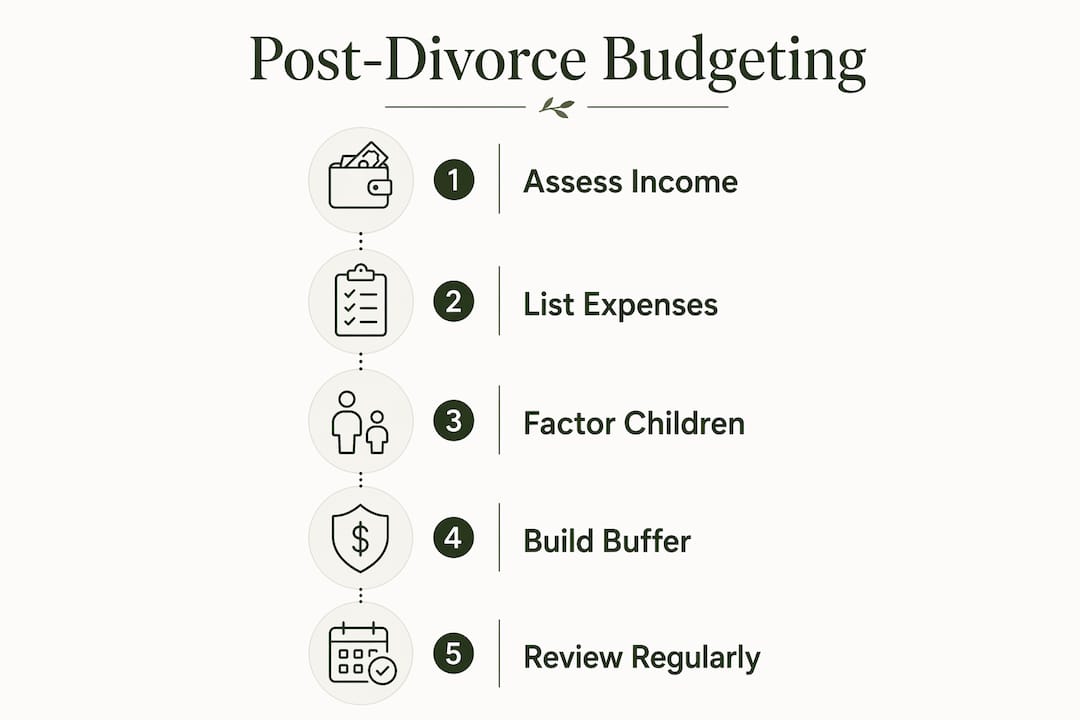
Start by separating your expenses into two categories:
Non-discretionary (fixed, essential):
- Housing: rent or mortgage, property taxes, insurance
- Utilities: electricity, water, internet, phone
- Food and groceries
- Transportation: car payment, insurance, fuel
- Health insurance and medical costs
- Minimum debt payments
Discretionary (variable, adjustable):
- Dining out and entertainment
- Clothing and personal care
- Subscriptions and memberships
- Travel and vacations
For mothers, planning for children's future expenses is a separate line item entirely. Health insurance coverage, school tuition, extracurricular activities, and college savings all belong in your long-term financial plan, not as afterthoughts.
| Budget Category | Planning Consideration |
|---|---|
| Housing | Can you afford it alone? Factor in maintenance and taxes. |
| Health insurance | Will you stay on a spouse's plan or need your own? |
| Children's expenses | Include education, activities, and medical costs. |
| Emergency fund | Target 3–6 months of non-discretionary expenses. |
| Retirement contributions | Do not stop contributing. Time in the market matters. |
Use a post-divorce budget tool to model different scenarios before you finalize any settlement. A Certified Divorce Financial Analyst can translate these numbers into a realistic projection of your financial life five and ten years out. That perspective changes which settlement offers look attractive and which ones look like traps.
Pro Tip: Build a 10% buffer into your monthly budget for the first year post-divorce. Unexpected costs, from car repairs to legal modifications, are common and hit hardest when you have no margin.
Key Takeaways
A complete divorce checklist for women combines early document collection, independent financial setup, legal clarity, and a realistic post-divorce budget to protect long-term security.
| Point | Details |
|---|---|
| Gather documents early | Collect 3–5 years of tax returns and 12+ months of financial statements before filing. |
| Build financial independence | Open individual accounts and an emergency fund before proceedings begin. |
| Understand asset liquidity | A large settlement means nothing if the assets drain your cash flow post-divorce. |
| Update beneficiary designations | Divorce decrees do not change life insurance or retirement account beneficiaries automatically. |
| Budget for real life | Separate fixed from variable expenses and include children's long-term costs in your plan. |
Why financial preparation matters more than emotional readiness
Legal and emotional readiness rarely arrive at the same time. Women often spend years building the emotional courage to file, only to walk into the process with no financial documentation, no individual accounts, and no clear picture of what they own or owe. That gap is where settlements go wrong.
The women who come out of divorce in the strongest position are not the ones who felt the most ready emotionally. They are the ones who quietly organized their finances, got early legal advice, and resisted the urge to make impulsive moves out of anger or fear. Closing a joint account in a moment of frustration, or transferring assets to a family member, creates legal problems that take months and thousands of dollars to untangle.
Legal and emotional readiness rarely align, and that is not a personal failure. It is just the reality of how divorce works. The practical response is to treat financial preparation as something you can control right now, regardless of where you are emotionally. Hire a family law attorney for a consultation before you file. Talk to a Certified Divorce Financial Analyst before you agree to any settlement. These conversations are far cheaper than fixing mistakes after the fact.
Divorce is a transition that rewards preparation. The checklist is not just paperwork. It is the structure that keeps you from making decisions under pressure without the information you need.
— Landon
Divvi makes the paperwork side manageable
Pulling together a complete women's divorce checklist is a lot of work, especially when you are also managing the emotional weight of the process. Divvi was built to take the document and process burden off your plate.
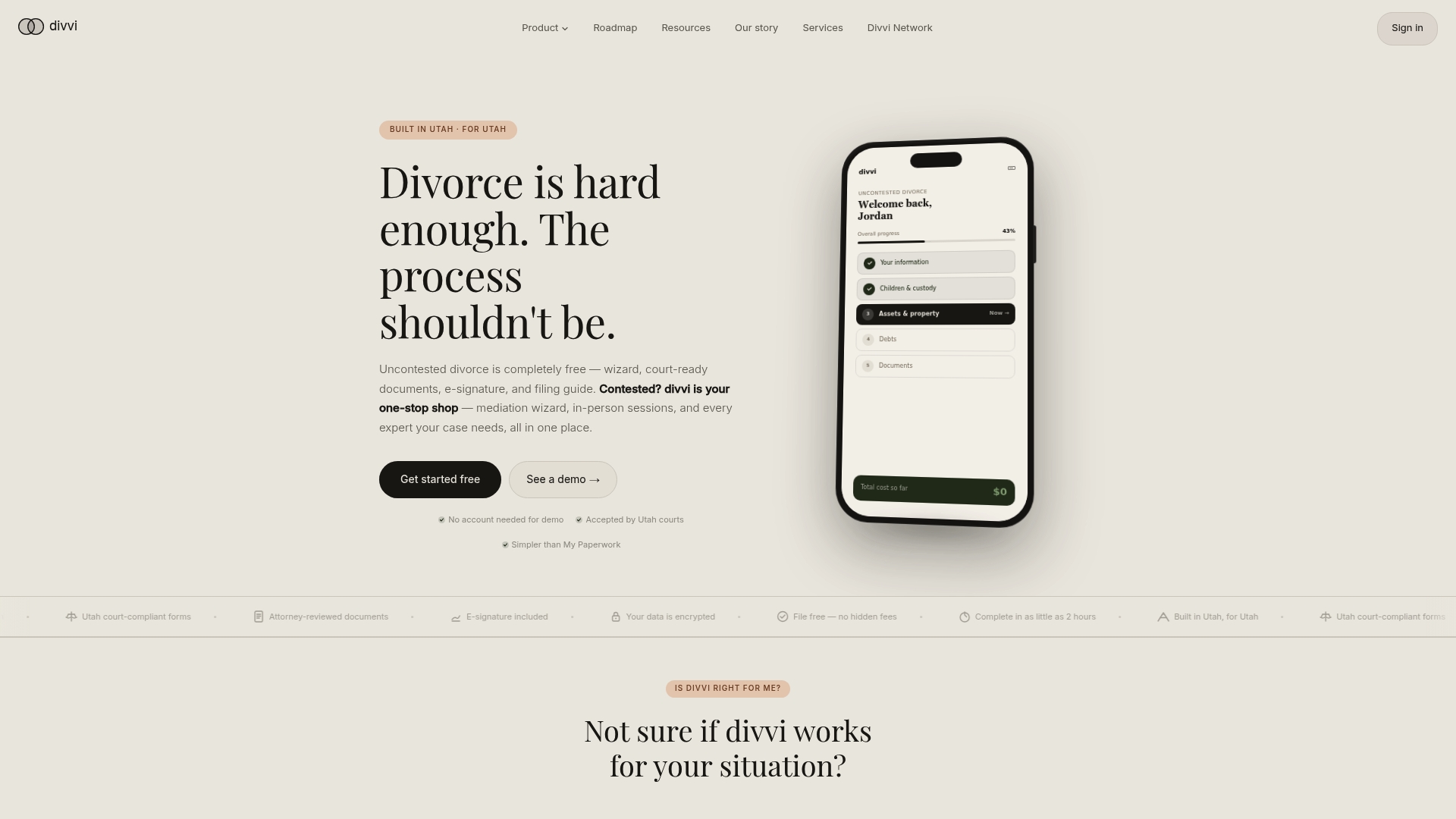
Divvi's free divorce wizard walks you through every step of the Utah divorce process, generating documents designed for filing without the cost of a traditional attorney for straightforward cases. The document audit tool helps you identify exactly what paperwork you have and what is still missing. For families with children, the family management plan tool organizes custody details and parenting arrangements in one place. Divvi also connects you with attorneys, mediators, and financial advisors when your situation needs more than documents. The base platform is free to use, and you pay only for the services you actually need.
FAQ
What documents should I gather first for a divorce?
Start with 3–5 years of federal and state tax returns, 12 months of bank and credit card statements, and retirement account statements. These give you the clearest picture of marital assets and liabilities before any legal process begins.
How do I protect my credit during a divorce?
Pull your credit reports from all three major bureaus at annualcreditreport.com and open an individual credit card in your name only. Monitor your reports monthly to catch any new joint accounts or inquiries.
Should I close joint bank accounts before filing for divorce?
Closing joint accounts before filing can alert your spouse and create financial instability. Open individual accounts quietly first, then work with your attorney on the timing of separating joint finances.
What is a Certified Divorce Financial Analyst?
A Certified Divorce Financial Analyst (CDFA) is a financial professional trained to model divorce settlement scenarios, including tax implications and long-term cash flow projections. Their analysis helps you evaluate which settlement offers are actually sustainable.
Do I need to update my will after divorce?
A divorce decree does not automatically update your will, beneficiary designations, or estate planning documents. You must revise these proactively after the divorce is final to avoid unintended outcomes.