Right of First Refusal in Utah: Advisory, Not Automatic
Written and reviewed by the divvi team. How we research and check this.

What is the right of first refusal in Utah custody cases?
The right of first refusal in Utah child custody law is a recommended guideline, not an automatic legal right. Under Utah Code § 81-9-202, the statute establishes this provision as advisory, meaning it only becomes enforceable when a court explicitly includes it in a custody decree or parenting plan. If your current order does not mention it, you cannot simply invoke it and expect compliance.
The core idea is straightforward: when one parent is unavailable to care for the child during their scheduled parenting time, they must offer that time to the other parent before arranging childcare through a third party, such as a babysitter, grandparent, or daycare. The goal is to maximize each parent's time with the child rather than outsourcing care unnecessarily.
Family law attorney Scott Wiser of Wiser Law stresses that parents frequently misread the statute. Calling it a mandatory right without an explicit court order is legally unfounded. The provision sits in Utah's parenting time guidelines as a recommendation, and courts will not enforce it unless it appears in the actual decree.
Key legal points to understand:
- Utah Code § 81-9-202 lists the right of first refusal as an advisory guideline within Utah's minimum parenting time standards.
- The right becomes binding only when a judge signs it into a court order or both parents incorporate it into a written, court-approved parenting plan.
- Its primary purpose is to prioritize parental involvement over third-party childcare during the other parent's scheduled time.
- Without explicit language in the decree, a parent who ignores the other's request to care for the child faces no legal consequence.
- Adding the right after a divorce requires a formal modification petition, not just a verbal agreement between parents.
The bottom line: Advisory status under Utah law means the right of first refusal carries no automatic legal weight. It must be written into your court order to be worth anything.
How the right of first refusal actually works in daily parenting time
The right triggers when one parent becomes unavailable during their scheduled parenting time for longer than a defined minimum period. Most Utah parenting plans that include this provision set that threshold at a few hours, a range that family law practitioners widely recommend because it prevents the clause from becoming a source of constant friction over brief absences.
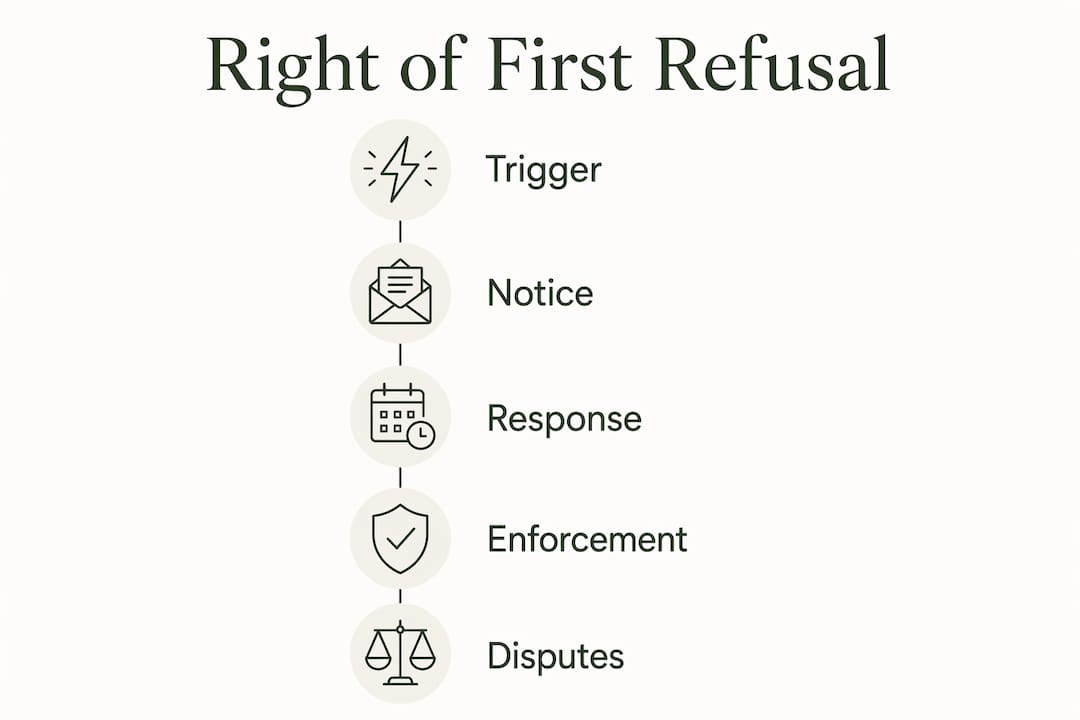
Think about what that looks like in practice. A parent has the kids on a Tuesday evening but needs to attend a work meeting that runs three hours. Under a properly drafted first refusal clause, that parent must contact the other parent first and offer them the time before calling a babysitter. The other parent then has a defined window, often one to two hours, to respond and accept or decline.
Practical steps and conditions that typically govern the right:
- The triggering absence must exceed the agreed minimum time threshold, most often set at 3 to 4 hours.
- The parent who is unavailable must notify the other parent promptly, using the communication method specified in the decree (text, email, or a co-parenting app).
- The notified parent must respond within the timeframe set in the agreement, often within one to two hours.
- If the notified parent declines or does not respond in time, the unavailable parent may arrange alternative childcare.
- The right applies during scheduled parenting time only, not during school hours or other pre-arranged activities.
- Neither parent can waive the right informally; any permanent change requires a court-approved modification.
Pro Tip: Use a dedicated co-parenting communication app like TalkingParents or OurFamilyWizard to document every first refusal notice and response. Timestamped records become critical evidence if a dispute ever reaches a judge.
A common scenario: a mother has her children every other weekend. On a Saturday afternoon, she has a four-hour commitment. Under the clause, she texts the father at 9 AM, he responds by 10 AM accepting the time, and the kids spend the afternoon with him instead of a neighbor. No conflict, no court involvement. That is the clause working exactly as intended.

How Utah courts view and enforce the right of first refusal
Utah courts do not treat the right of first refusal as a tool for maximizing parental time at any cost. The guiding principle in every custody decision is the child's best interest, and judges weigh whether enforcing the right actually serves that standard in a given situation. A parent who demands enforcement when doing so would disrupt the child's school schedule, extracurricular activities, or established routine may find the court unsympathetic.
Scott Wiser puts it plainly:
Courts focus on two practical questions when enforcement comes up: Is the clause clearly written enough to enforce? And does enforcement serve the child's routine rather than disrupt it? A clause that says "the other parent shall be given reasonable notice" answers neither question, which is why courts enforce only clear, well-drafted clauses that specify time thresholds, notice methods, and response windows.
When one parent ignores a valid first refusal clause, the other parent's legal options depend on how the decree is structured. The most common path is filing a motion for contempt, which asks the court to find the non-complying parent in violation of the order. Alternatively, if the original decree language is ambiguous, a parent may need to file for a modification to clarify or strengthen the clause. Neither process is fast or cheap, which is exactly why getting the language right at the outset matters so much.
Pro Tip: Before filing a contempt motion, document at least two to three clear violations with dates, times, and communication records. Judges expect a pattern, not a single incident, before finding contempt.
Drafting an effective first refusal clause for your Utah custody agreement
A first refusal clause that holds up in court needs specificity on four points: the time threshold, the notice method, the response window, and the consequences of non-response. Vague language is the single biggest reason these clauses fail. A clause that uses terms like "reasonable notice" or "as soon as possible" invites litigation because neither parent knows exactly what those phrases require.
The threshold of a few hours is the most widely accepted starting point in Utah. It is short enough to capture meaningful absences but long enough to exclude quick grocery runs or brief errands. Some parents with infants or very young children negotiate a shorter threshold, sometimes two hours, because young children's needs are more time-sensitive. Whatever number you choose, write it as a specific number of hours, not a subjective description.
Drafting best practices:
- State the exact time threshold in hours (e.g., "if the parent will be unavailable for more than three consecutive hours").
- Specify the communication method: text message to a defined phone number, email to a defined address, or a named co-parenting app.
- Set a firm response deadline, such as "the other parent must respond within two hours of receiving notice."
- State clearly what happens if the notified parent does not respond: the unavailable parent may arrange alternative childcare without penalty.
- Avoid the phrase "reasonable notice" entirely. Replace it with a specific time and method.
- Address what counts as "unavailable": work obligations, medical appointments, travel, and social events should all be explicitly included or excluded.
- Include a provision for emergencies, where the unavailable parent may arrange immediate childcare and notify the other parent as soon as practicable.
Effective clauses specify communication channels and response times because those details are what a judge can actually measure and enforce. A clause without them is closer to a suggestion than a legal obligation.
Pro Tip: Have a Utah family law attorney review your first refusal clause before the court signs the decree. A one-hour consultation to tighten the language costs far less than a contempt motion later.
Common disputes and challenges with the right of first refusal in Utah
The right of first refusal generates more post-divorce conflict than almost any other custody provision, and the reason is almost always the same: the clause was drafted too loosely, or one parent is using it for purposes it was never meant to serve.
The most frequent abuse involves short absences. One parent leaves for two hours and the other demands compliance with the clause, even though the parenting plan sets a three-hour threshold. This kind of friction is exhausting for both parents and, more importantly, for the children caught in the middle. Parents often trigger disputes over short absences or use the right as a pretext to monitor the other parent's schedule and social life.
Common issues Utah parents face:
- Threshold disputes: One parent claims an absence exceeded the threshold; the other disagrees. Without a clear, written number, both positions are defensible.
- Notice failures: The unavailable parent forgets to notify the other, or notifies them too late for the other parent to realistically accept.
- Monitoring and control: One parent uses the clause to track the other's activities, demanding to know why they were unavailable and with whom.
- Undefined response windows: The notified parent takes six hours to respond, leaving the unavailable parent unable to arrange childcare in time.
- Scope creep: Parents argue about whether school events, work travel, or medical appointments trigger the right.
- Informal modifications: Parents agree verbally to waive the right in a given instance, then one later claims the other violated the decree.
The right of first refusal should focus on parental involvement, not surveillance. When one parent starts demanding explanations for every absence, the clause has shifted from a child-centered tool to a conflict generator. Courts notice this pattern, and it rarely helps the controlling parent's credibility.
Utah law also does not create exceptions for every imaginable scenario, so gaps in the clause become battlegrounds. If the agreement does not address work travel, a parent who travels frequently for work may face repeated demands that are impractical to honor. Drafting the clause to address your actual family circumstances, not a generic template, prevents most of these problems before they start.

How Divvi helps Utah parents prepare custody agreements with confidence
Getting a first refusal clause right requires more than copying language from a generic template. It requires Utah-specific guidance, an attorney who can check the language, and a process that accounts for your actual family situation. That is exactly what Divvi was built to provide.
Divvi's platform walks Utah parents through custody agreement preparation with a step-by-step wizard that generates documents designed for filing tailored to Utah law. You are not guessing at language or hoping a template holds up in court. You can have an attorney check the language before you finalise it, which means the first refusal clause in your parenting plan will be specific, enforceable, and aligned with what Utah judges actually expect to see.
What Divvi offers parents navigating custody agreements:
- A step-by-step document wizard that generates custody and parenting plan documents designed for filing specific to Utah law.
- An optional attorney referral, so a lawyer can check that your first refusal clause and other provisions meet the standards Utah courts enforce.
- Mediation support, both AI-assisted and with human mediators, for parents who need help reaching agreement on contested provisions.
- Connections to Utah family law attorneys, financial advisors, and real estate professionals when your situation requires additional expertise.
- Post-divorce decree modification support for parents who need to add or update a first refusal clause in an existing order.
- A free base model, so you pay only for the services your specific situation requires.
If your current custody order does not include a first refusal clause and you want to add one, Divvi's modification tools guide you through the petition process without requiring you to hire a full-service attorney for the entire case. You can also use the family management plan tools to draft and formalize parenting time arrangements from the start.
The platform's approach reflects a straightforward reality: most custody disputes, including those over the right of first refusal, stem from documents that were never clear enough in the first place. Starting with well-drafted, carefully checked language is the most practical thing you can do for your family's long-term stability.
Key Takeaways
The right of first refusal in Utah child custody is only enforceable when explicitly written into a court-approved parenting plan, and clear, specific language in that clause determines whether it protects your parental time or generates conflict.
| Point | Details |
|---|---|
| Advisory, not automatic | Utah Code § 81-9-202 makes the right of first refusal a guideline; it requires explicit court order inclusion to be enforceable. |
| Time threshold matters | A 3 to 4 hour minimum threshold is the widely recommended standard to prevent disputes over brief absences. |
| Vague language fails | Terms like "reasonable notice" invite litigation; clauses must specify communication methods and response windows. |
| Courts prioritize the child | Utah judges enforce the right only when doing so serves the child's stability, not simply to maximize a parent's time. |
| Modification is the path forward | If your current decree lacks the clause, a formal modification petition is required to add it. |