Is Utah a Community Property State? 2026 Guide
Written and reviewed by the divvi team. How we research and check this.

Utah is an equitable distribution state, not a community property state, meaning courts divide marital assets fairly rather than splitting them 50/50 by default. That single distinction shapes every property decision in a Utah divorce. Knowing which system applies changes how you document assets, negotiate settlements, and plan your financial future. This guide explains how Utah's property division actually works, what courts look at, and how to protect what is yours.
Is Utah a community property state?
Utah is not a community property state. Under Utah Code § 81-4-204, effective September 1, 2024, courts divide marital property equitably, which means fairly given the circumstances, not automatically in half. Nine states follow community property rules, where each spouse owns exactly 50% of assets acquired during the marriage. Utah gives judges discretion to weigh each couple's unique situation and reach a result that fits.
Community property sounds simple, but it removes judicial flexibility. A couple married for 30 years gets the same 50/50 default as a couple married for two years in a community property state. Utah's equitable distribution model treats those two situations very differently. That flexibility is the defining feature of Utah marital property law.

The procedural basics matter too. As of may 2026, filing for divorce in Utah costs $358, requires 90 days of residency in the county where you file, and carries a mandatory 30-day waiting period. These requirements apply regardless of how complex or simple your property situation is.
How is marital property defined and classified in Utah?
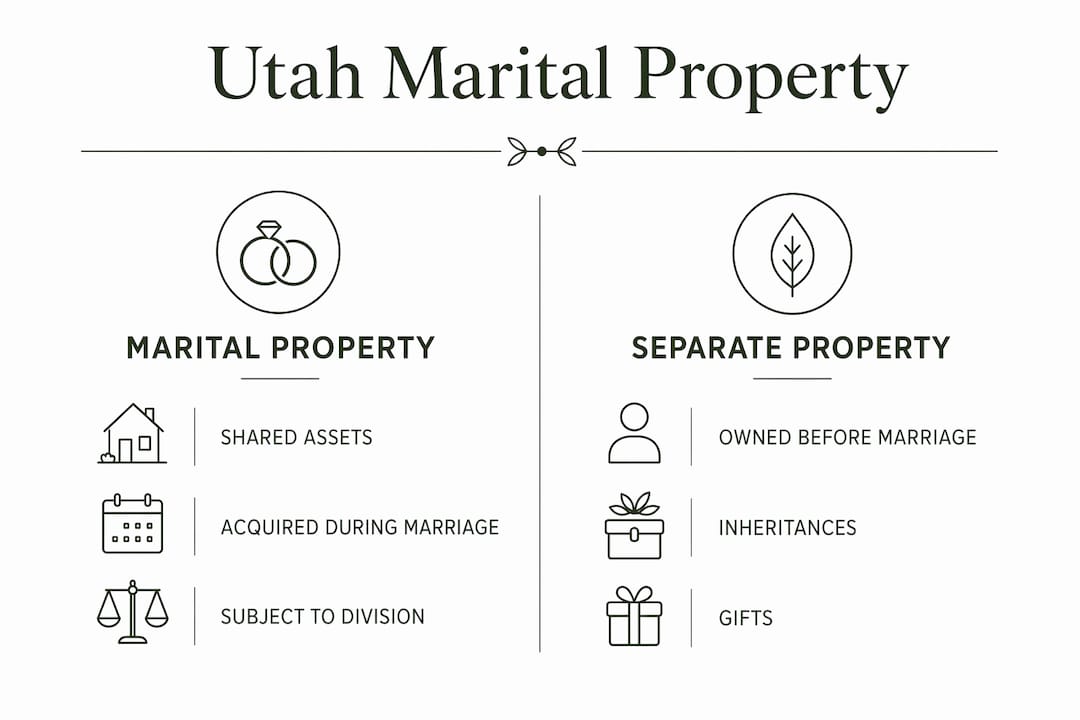
Marital property is every asset acquired by either spouse during the marriage. That includes wages, retirement contributions, real estate purchased together, and debt taken on as a couple. The classification of an asset as marital or separate is one of the most consequential decisions in a Utah divorce.
Separate property stays outside the marital estate. Common examples include:
- Property owned before the marriage
- Inheritances received by one spouse, even during the marriage
- Gifts given specifically to one spouse
- Personal injury settlements for pain and suffering
The problem is that separate property can lose its protected status. Commingling separate assets with marital funds is the most common way this happens. If you inherit $40,000 and deposit it into a joint checking account used for household expenses, a court may classify that money as marital property. The same applies to using inheritance funds to pay down a joint mortgage.
Marital contributions to a separate asset can also change its classification. If your spouse spent years maintaining or improving a rental property you owned before the marriage, a court may recognize a marital interest in the appreciation that occurred during that period.
Pro Tip: Keep a dedicated account for any inherited or gifted funds. Never mix those funds with joint accounts. That single habit preserves the paper trail you need to prove separate property status.
Tracing separate assets requires clear documentation. Without proper records, courts default to classifying disputed assets as marital property subject to division. The burden of proof falls on the spouse claiming something is separate, not on the other party.
What factors do Utah courts consider when dividing property?
Utah courts use broad judicial discretion under Utah Code § 81-4-204 to reach an equitable outcome. A 50/50 split is a common starting point, but it is a presumption, not a rule. Courts can and do deviate from equal division when the facts justify it.
The main factors courts weigh include:
- Duration of the marriage. Longer marriages typically produce more equal splits. Shorter marriages often result in each spouse being restored to their pre-marriage financial position.
- Each spouse's contributions. Financial contributions matter, but so do non-financial ones. A spouse who left the workforce to raise children made a real economic contribution.
- Income and earning capacity. A significant gap in earning potential can shift the division in favor of the lower-earning spouse.
- Health and age. A spouse with a serious medical condition or limited working years may receive a larger share.
- Needs of minor children. Courts may award the family home to the parent with primary custody to minimize disruption for children.
- Financial misconduct. Hiding assets, running up debt, or dissipating marital funds can result in a less favorable outcome for the offending spouse.
Long-term marriages of 15 or more years in Utah typically result in approximately equal division of marital property. Short-term marriages of five years or less lead courts to try restoring each spouse to their pre-marriage financial position rather than splitting assets down the middle.
That distinction matters enormously in practice. A couple married for three years who bought a house together may walk away with the equity each contributed, rather than splitting the total 50/50. A couple married for 25 years faces a very different calculation.
Utah courts hold broad authority to award unequal shares when exceptional circumstances exist. Financial misconduct is the clearest example. If one spouse drained retirement accounts or hid income, the court can compensate the other spouse through a larger property award.
How is the family home treated in Utah divorce property division?
The family home is marital property when purchased during the marriage with marital funds. That is true even if only one spouse's name is on the deed. Courts treat the home as a shared asset and must decide how to resolve ownership at divorce.
Three standard resolutions exist for the marital home:
- Buyout. One spouse pays the other for their share of the equity and keeps the home. This requires refinancing the mortgage in the buying spouse's name alone.
- Sale and split. The couple sells the home and divides the net proceeds according to the court's equitable formula.
- Offset award. One spouse receives the home while the other receives assets of comparable value, such as retirement accounts or investment funds.
Courts typically require a professional appraisal of the family home for buyouts or contested divisions. The appraisal establishes fair market value, which anchors the equity calculation. Skipping this step creates disputes that cost more to resolve than the appraisal itself.
Pro Tip: Order your own independent appraisal before negotiations begin. If your spouse's appraisal comes in significantly lower, you have grounds to challenge it. Two appraisals that differ widely often lead courts to average the two figures.
Separate property funds used on the home complicate the picture. If you paid the down payment with money you owned before the marriage and can document that clearly, you may be entitled to a credit for that contribution before the remaining equity is divided. Without documentation, that pre-marital contribution disappears into the marital estate.
What practical steps can Utah residents take to protect their assets?
Preparation before and during divorce proceedings directly affects outcomes in an equitable distribution state. Utah courts rely heavily on the documentation each party presents. The spouse who arrives with organized records almost always fares better than the one who does not.
Concrete steps to take now:
- Document separate property immediately. Gather bank statements, gift letters, inheritance records, and purchase receipts that establish the origin of any asset you claim as separate.
- Stop commingling funds. Open a separate account for any separate property funds you receive going forward. Do not deposit them into joint accounts.
- Track marital contributions to separate assets. If marital money paid for improvements to a property you owned before marriage, document both the contributions and the resulting value increase.
- Understand your full financial picture. Collect statements for all accounts, retirement plans, real estate holdings, and debts. Courts divide the full marital estate, including liabilities.
- Consult a legal professional early. Property classification questions are easier to answer before divorce filings than after. An attorney can identify which assets are at risk before the process begins.
- Consider mediation. Mediation lets both spouses negotiate property division directly, often reaching agreements that courts would not impose. It is faster, cheaper, and gives both parties more control over the outcome.
Proper classification of assets early in divorce proceedings is the single most effective way to avoid unintended loss of separate property. Waiting until trial to raise classification arguments is expensive and often unsuccessful.
Key takeaways
Utah follows equitable distribution, not community property rules, meaning courts divide marital assets fairly based on each couple's specific circumstances rather than splitting everything in half.
| Point | Details |
|---|---|
| Utah is not a community property state | Courts divide marital assets equitably under Utah Code § 81-4-204, not automatically 50/50. |
| Marriage duration drives outcomes | Marriages of 15+ years typically see near-equal splits; marriages of 5 years or less often restore pre-marriage positions. |
| Commingling destroys separate property status | Mixing inherited or pre-marital funds with joint accounts can reclassify them as marital property. |
| Documentation is the deciding factor | The spouse who traces and proves separate property with clear records keeps it; the one without records loses it. |
| The family home requires a formal appraisal | Courts rely on professional valuations to resolve buyouts and contested home division fairly. |
What equitable distribution looks like in practice
The phrase "equitable distribution" sounds reassuring until you realize how much work it puts on you. Community property states hand you a simple rule: everything acquired during the marriage is split in half. Utah's system asks courts to weigh a dozen factors and reach a "fair" result. That flexibility is genuinely better for most people, but only if they show up prepared.
The biggest mistake I see Utah residents make is assuming the court will figure out what is fair on their behalf. Courts work with the evidence presented. If you cannot trace a $60,000 inheritance because you deposited it into a joint account eight years ago, that money is gone from a legal standpoint. The court is not going to reconstruct your financial history for you.
Short-term marriages are where I see the most surprises. Residents assume that because they contributed more to the marriage financially, they will walk away with more. That is not always true. Courts look at what each spouse needs to re-establish themselves, not just who earned more. A spouse who gave up a career to support the household has a legitimate claim even in a two-year marriage.
Appeals on property division decisions are rare and difficult to win. Appellate courts defer to the trial court unless there is a clear abuse of discretion or a fundamental legal error. That reality makes getting it right the first time the only realistic strategy. Mediation, solid documentation, and early legal advice are not optional extras. They are the foundation of a fair outcome.
— Landon
How Divvi simplifies Utah property division
Utah's equitable distribution rules create real complexity, and most residents face them without a clear roadmap.
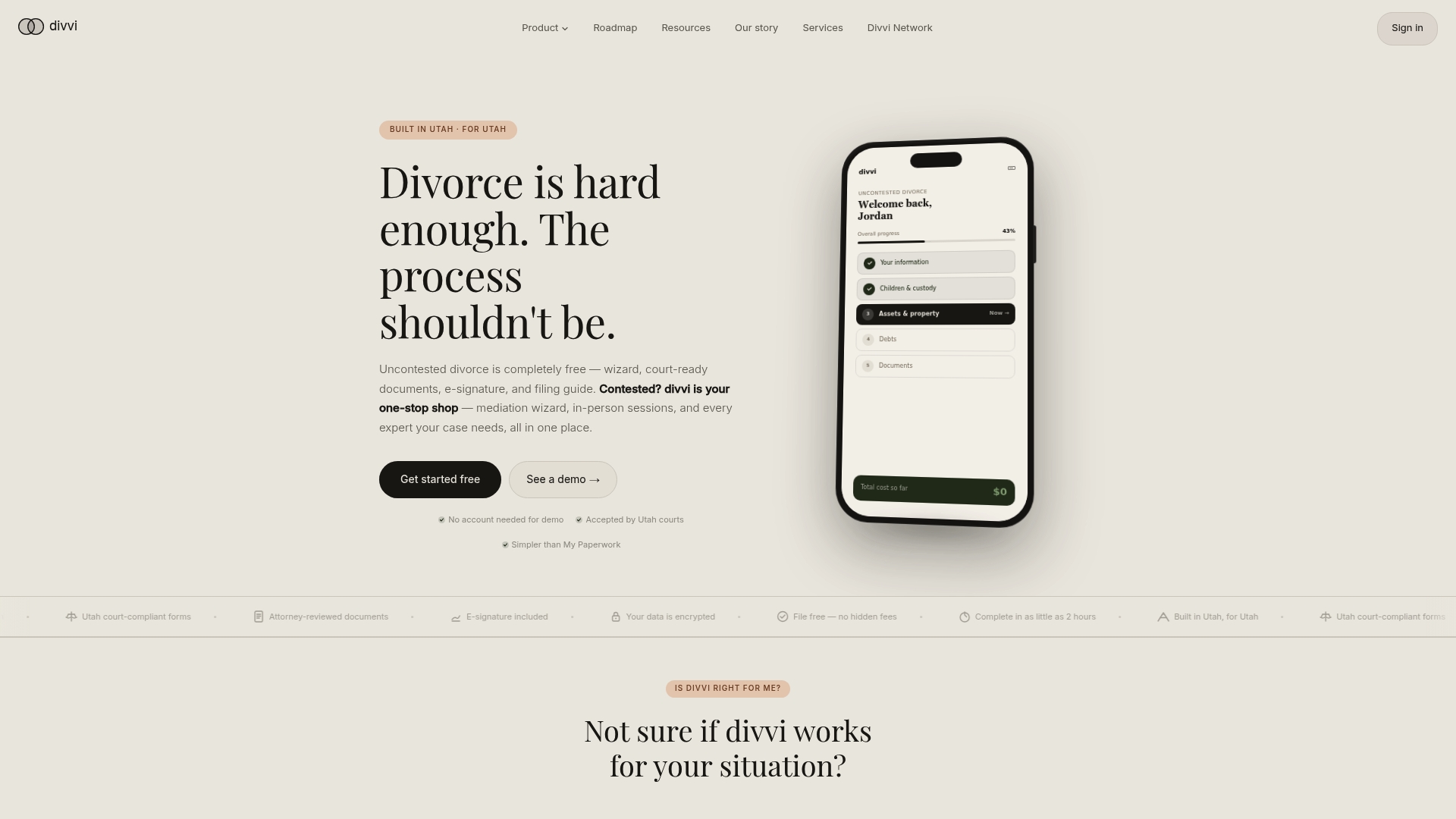
Divvi is built specifically for Utah families navigating divorce. The platform walks you through asset classification, generates documents designed for filing, and connects you with mediators when both spouses need help reaching a property agreement. The Utah divorce platform handles everything from simple uncontested cases to situations involving contested assets and uncooperative spouses. The base model is free to use, and you pay only for the specific services you need, whether that is document preparation or mediation. divvi is not a law firm and can't give legal advice. If the family home, retirement accounts, or separate property claims are part of your situation, Divvi's document audit tool helps you organize and verify your records before filing.
FAQ
Is Utah a community property state?
No. Utah is an equitable distribution state under Utah Code § 81-4-204. Courts divide marital property fairly based on each couple's circumstances, not automatically in half.
What counts as marital property in Utah?
Marital property includes all assets and debts acquired by either spouse during the marriage. Separate property, such as pre-marital assets, inheritances, and gifts, is excluded unless it has been commingled with marital funds.
How does the court divide the family home in a Utah divorce?
Utah courts resolve home ownership through a buyout, a sale with proceeds split equitably, or an offset where one spouse keeps the home and the other receives assets of comparable value. A professional appraisal is typically required.
Can a judge split property unequally in Utah?
Yes. Utah courts have broad discretion to award unequal shares when circumstances justify it, including financial misconduct, large differences in earning capacity, or the needs of minor children.
How do I protect my separate property in a Utah divorce?
Keep separate property funds in dedicated accounts, maintain clear documentation of their origin, and avoid using them for joint expenses. Without a traceable paper trail, courts will likely classify disputed assets as marital property.